The Day Rome Fell
A few days had passed since Hadrian had been proclaimed emperor. In the Forum, people were still talking about it as though it were news like any other. Merchants argued over the price of grain, a scribe read aloud the names of the dead from the previous night, and before the Temple of Saturn men crowded together, wanting to know whether the new emperor would end the war with the Parthians.
I stood by the steps of the Rostra, waiting for a man who was meant to give me a written acknowledgment of a debt. I remember the heat of the stone beneath my sandals. The smell of oil, sweat, and the refuse caught between the paving stones. A dove perched on the head of a statue.
Then the earth shook.
Not once. Again and again. The Forum swayed beneath us as though some enormous beast lay below, struggling for breath in its sleep. The columns of the Temple of Saturn groaned. A dull blow came from the Curia Julia, and then part of its roof collapsed. People ran before they even knew what they were running from.
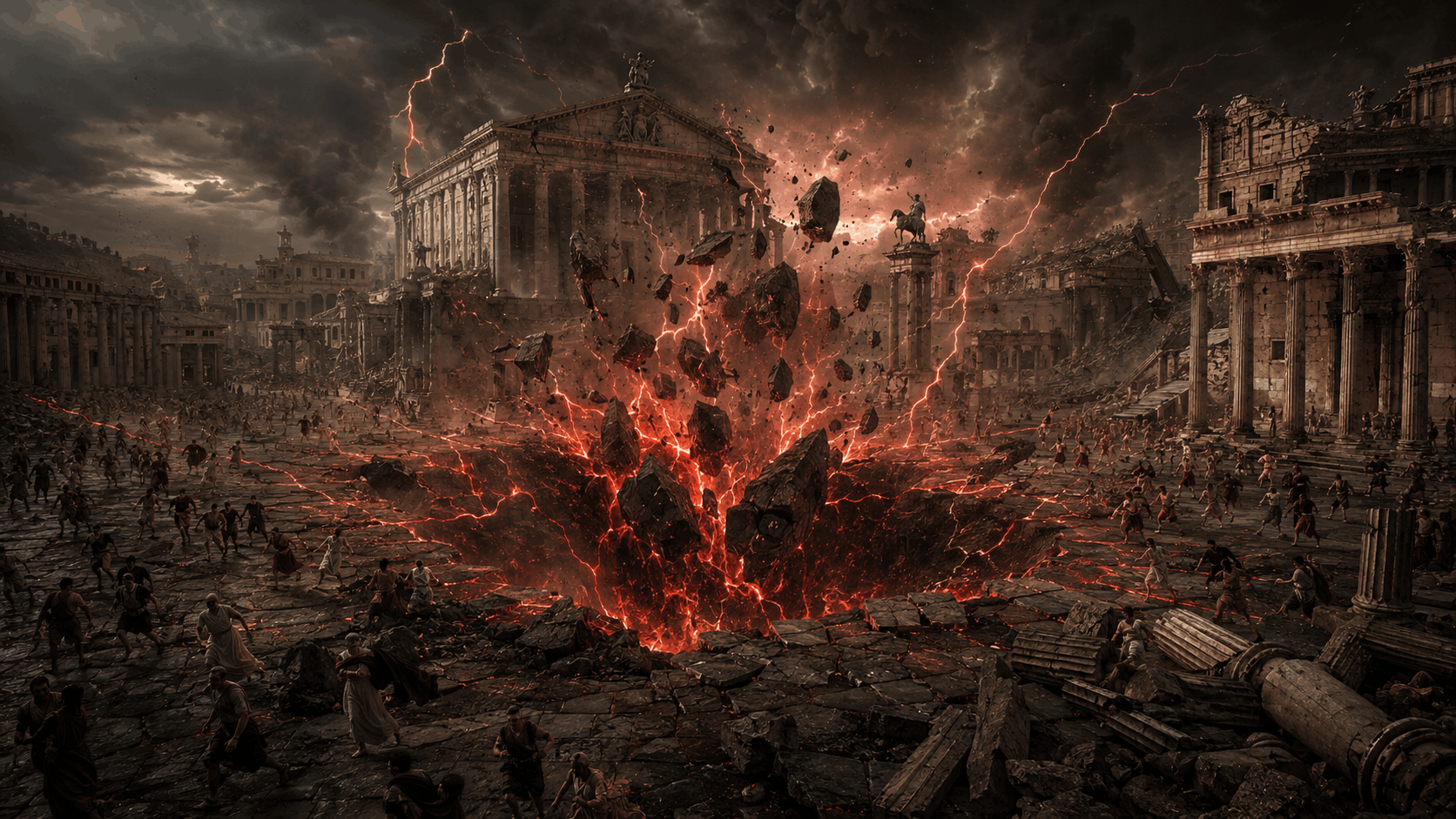
The first fissure opened among the stalls.
I can call it nothing else. The ground did not burst. Nor did it split like a collapse. Something black opened within it, a depth without a bottom, ringed by glowing red lines. Paving stones tore free of the ground and hung in the air. Between them lightning flickered, red as molten iron.
A man beside me raised his hand to shield his face. The lightning struck him without thunder or warning. For an instant he was nothing but a bright shape. Then he lay among the stones. The woman who had been with him fell to her knees and called his name.
The man stood again.
Not like an injured man. Not like someone waking from sleep. He rose even though his neck hung at an angle no living body could endure. The woman backed away. He reached for her. The same thing was happening all around us. Anyone who had come too close to the red light rose again as soon as the smoke cleared.
Then the Forum broke apart.
The columns of the Temple of Castor and Pollux fell into the crowd. Fire leapt from roof to roof. The sky above the Palatine turned black though it was still midday, and in the darkness thunder rolled without pause. No one gave orders anymore. The men carrying the city watch's staffs ran alongside merchants, slaves, and senators. Rome had known a place for each of us. On that day, no one knew where they belonged.
Something emerged from the fissure that did not belong among the dead.
At first I saw only a hand, too long and too thin, with joints in places where no joints should be. Then two pale points in the depths. Perhaps they were eyes. Perhaps only fire. The figure hauled itself onto the stones, and wherever it touched them, the paving turned red and began to smoke. More shadows moved behind it.
I ran.
Down the Via Sacra, past people praying on their knees and others fighting the dead without understanding why their swords changed nothing. A child clung to its mother's hand. Then a falling column struck between them, and the child was left alone. It called for her, but no one stopped. Before the Arch of Titus, the crowd pressed together, but the road no longer led where it always had. A fissure yawned between the arches. Beyond it, I saw the sky itself flicker.
I found refuge in a cellar near the Subura. There were nine of us, including a man the others had dragged away from the Forum. The red lightning had killed him, but no one wanted to leave a dead man outside. When he opened his eyes again in the cellar and reached for us, we forced him out and barred the door. After that, there were only eight of us.
I do not know how long I stayed in that cellar. When I emerged again, Rome was burning in more places than I could count. A red glow hung above the Forum. The fissures were still open.
They say Rome has fallen when its walls fall. That is not true. Rome fell when no one knew anymore what was human and what returned from the darkness.